
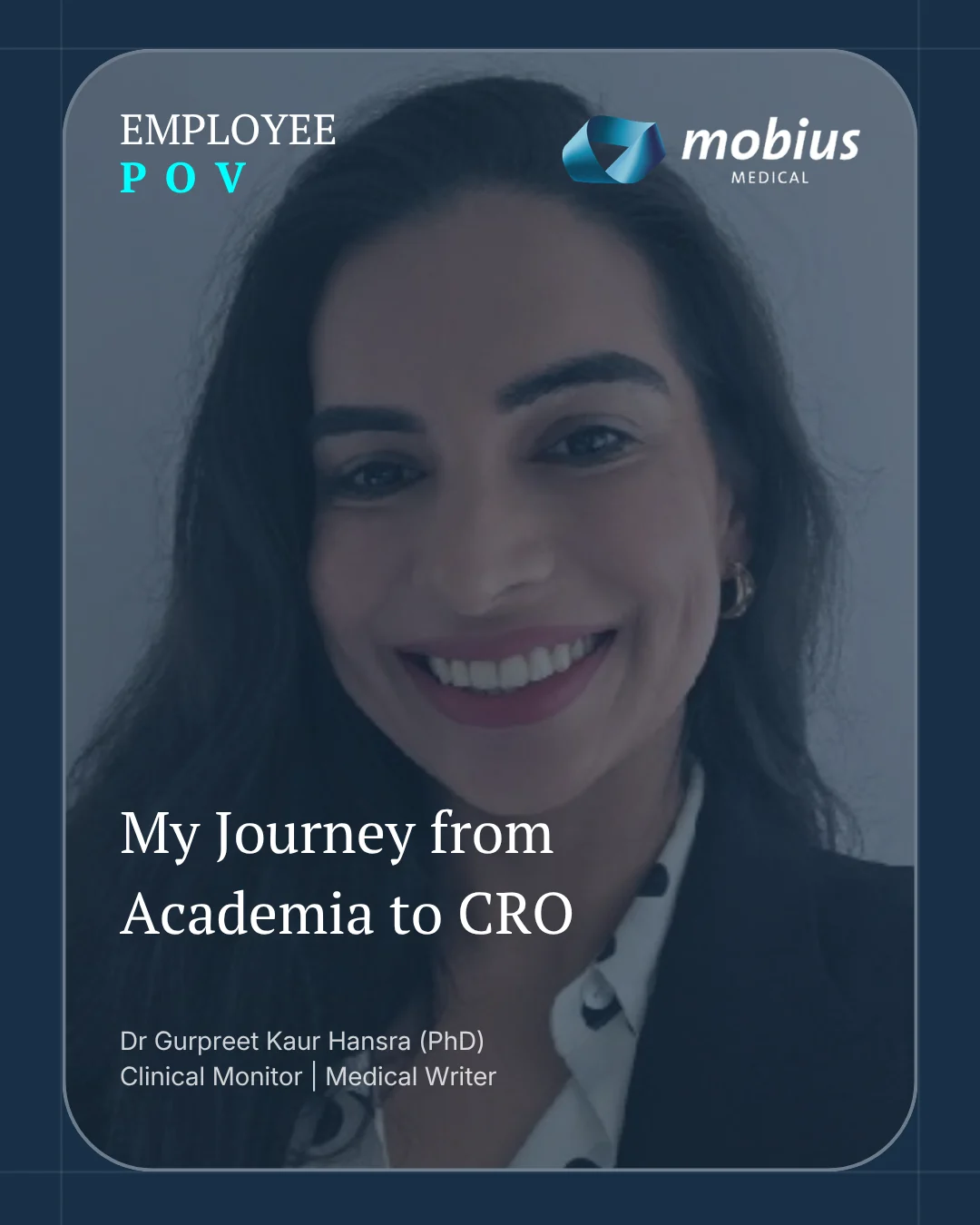
Dr Gurpreet Kaur Hansra reflects on her journey from dementia research in academia to clinical research, connecting scientific rigour with patient outcomes.
My professional journey has been rooted in a passion for neuroscience, scientific discovery, and improving outcomes for patients affected by complex neurological conditions. Beginning in academia with a focus on dementia research, I was driven not only by intellectual curiosity but also by the human impact behind the science.
Over time, my experiences in academia from leading a large multinational cohort study in Vascular Cognitive Impairment and Dementia shaped not only my scientific expertise but also my perspective on the broader role research can play in improving patients’ lives. While I valued the depth and rigour of academic research, which I believe remains equally important, I became increasingly motivated by the opportunity to contribute to environments where scientific findings could be translated more directly into improving patient outcomes. That motivation ultimately led me to transition into a CRO, a journey that unexpectedly began with a single MedTech conference, where I first heard about the powerful intersection of science and real-world healthcare impact during a panel discussion with the Mobius Medical co-founder, Suzanne Williams.
Combining Scientific Depth with Industry Agility
The transition into the CRO world has expanded my perspective beyond research alone. I have developed a deeper understanding of working alongside multiple regulatory and governance bodies, such as HRECs and RGOs, while also recognising the importance of stakeholder engagement, operational excellence, and aligning scientific innovation with practical execution.
One of the biggest shifts for me was appreciating the importance of systems, processes, and SOPs within the CRO environment. In academia, research is often driven by curiosity and flexibility, whereas in a CRO, consistency, quality, operational compliance, and reproducibility are essential. I learned that SOPs are not just administrative documents, but foundational tools that ensure scientific integrity, operational efficiency, and ultimately, patient safety. Every protocol, case report form, regulatory document, dataset, and communication within a clinical trials CRO setting carries significant weight because each contributes to the integrity, traceability, and compliance of the broader clinical development process. Unlike academia, where projects may often remain within a single institution or research group, CROs work simultaneously across multiple stakeholders, including sponsors, hospitals, ethics committees, investigators, and regulatory authorities. This requires a much deeper level of project management, communication, document control, and operational oversight to ensure studies remain compliant, efficient, and patient-focused throughout the entire clinical trial lifecycle. That perspective fundamentally changed the way I approach research and professional responsibility.
It reinforced for me that patient safety, data integrity, and trial quality depend just as much on operational discipline and accountability as they do on the science itself. Importantly, my journey has shown me that academia and industry are not separate worlds, but complementary parts of a larger healthcare and research ecosystem. Academia builds knowledge and scientific foundations, while CROs help translate that science into actionable outcomes that can benefit patients more directly and efficiently.
Looking Ahead
Looking back, my transition from dementia research in academia to the CRO industry has been more than a career move. It has been an evolution in how I contribute to healthcare. The curiosity, discipline, and scientific rigour developed during my academic years remain central to who I am professionally, while the CRO industry has allowed me to apply those strengths in ways that are collaborative, fast-paced, and impact-driven.
Today, I remain passionate about advancing healthcare innovation and contributing to meaningful scientific progress. This work feels deeply personal, serving as a constant reminder that at the centre of everything we do in a CRO are the patients we ultimately strive to help: patients searching for hope, for more time, and for a better quality of life. Behind every clinical trial is someone waiting for a treatment that could change their future, and that perspective continues to give deeper meaning and purpose to the work I do every day.